Welcome to Key Stage 3
Key Stage 3 is the gateway to all students joining West Lancashire Community High School. The journey that they will begin in Key Stage 3 will prepare them for their next steps towards Key Stage 4, and then to either Key Stage 5 or provision beyond West Lancashire Community High School.
Our goals in Key Stage 3 are to create a safe and inclusive environment whereby students can develop their communication, social and emotional skills, and academic abilities alongside developing resilience, independence and self-belief. We aim to guide our students along their pathway to support them to achieve their personalised outcomes and to achieve their own goals and ambitions.


Transition to KS3
Before coming to West Lancashire Community High School, many processes will have already occurred as part of our transition process. All Transition Review meetings will have been attended by our staff and additional school visits undertaken if necessary. You will have been invited to a range of transition days both during the school day and after school, and these normally take place in the Summer term. Our staff will have also begun to collate vital assessment information for EHCP outcomes, English, Maths, and other appropriate information. All this information helps us to determine which classes the students will be allocated. Classes remain flexible throughout the year, with the vast majority finalised by October half term once we have welcomed students to our provision.
All classes follow a curriculum suitably adapted to provide opportunities for young people to achieve success (for more information please click HERE). Whenever possible we look for opportunities to learn outside the classroom in interesting and innovative ways.


Our class teachers are:
3W - Mrs McEvoy (Lead Practitioner Quality of Education), Mrs Holcroft (Assistant head teacher) and Miss Marshall
3L - Mr Lynch
3C - Miss Baxendell (Assistant KS3 Lead)
3H – Miss Wilson
3S - Mrs Seery (Departmental Lead)
3A – Mrs Reynolds
3B - Miss Chisnall
Classes are supported by our teaching assistants:
Mr Croft
Mr Machaj
Miss White
Miss Harrington-Ball
Miss Heder
Miss Washington
Miss Loines
Mrs Seddon
Miss Welsh
Miss Grabiec
Miss Harrison
Mrs Neale
Miss Cooper
Miss Marsh
Ms Marsden
Miss Mercer
Miss Evans
Mrs Gordon
Mrs Breckell
Mrs Ward
Mrs Sneesby
Mrs Johnson
Miss Matthews
Miss Fazackerley (Wed, Thurs)
Mr Hill
Our experienced team of teaching assistants are based in the class groups but will move around within the department to ensure the students benefit from their expertise.
Pastoral Groups
Currently, we are made up of 7 mixed-age classes of Year 7’s, 8’s and 9’s. Students are grouped in classes based on a combination of ability need, and these groups remain flexible, guided by a consistent student-centred approach.


Core Learning
Students access Core Learning (CLL and Maths) in the mornings 4 times per week. Learning is tailored to their personal ability, needs and motivators. Student's progress is assessed regularly via our whole school assessment systems.


Expectations and Rewards
We take a positive stance towards our students in school and reward positive interactions, choices and engagement in learning rather than using sanctions. We focus on building positive relationships with our students in line with our whole school Relational Policy. We work on a token system across the department with a focus on money. Each class has a variant on this theme and is right for the students in those classes. Students earn money for achieving the 4 expectations on our school badge. At the end of the week, the money is added up and they can spend their money at the Key Stage 3 Shop.
Money is never removed as a consequence, but would not be given out when reflecting on the expectations. All students do have chances to gain extra coins for going 'above and beyond'. Rather than consequences, we prefer to use the term 'personal responsibility' to allow students to explore how they may approach situations differently in the future.


Communication
Communication is important to us and all parents and carers have access to teacher email addresses. Teachers will endeavour to respond to any questions or concerns within 48 on working days, as per our school policy. Home/School books are also available as a method of communication for some students. If you’d like one set up, please get in touch with your class teacher.


As a department, we are committed to inclusion and to supporting student’s communication. To support some of our students who may have communication needs, we follow a ‘Makaton sign of the week’ program. Every class learns a new Makaton sign each week, and this is displayed in classes. Students are celebrated for using these signs to communicate with their peers.
PROMOTING GOOD ATTENDANCE IN KEY STAGE 3
Attendance at school is vital for the development of our students. Not only does school provide the academic and cognitive development that enables progress but also the social, emotional and communication development. School is the best place for a young person to be.
As a school we set ourselves a target percentage to work towards. We have taken into consideration the needs of our students and allowed flexibility for medical appointments or interventions. This year our benchmark is 92%. Students falling under that percentage across a half term will receive a letter asking you to make contact with school.
We also recognise that our students may have medical needs or a range of other issues that may impede their ability to access school. In these situations, we cannot mark them as present but we can work together with parents to develop Attendance Care Plans that recognise the wider needs. Please speak to your class team or contact Mr. D Mullen for further advice.
School has a robust Attendance Policy and procedures for absences. Click here
PARENT INFORMATION
Below is a copy of the parent guidance for attendance at West Lancashire Community High School and includes a breakdown of the procedures used in school. Ultimately, as a school, we want to work in collaboration. If you are to receive an attendance letter, please do not worry, just make contact with the class team to arrange an informal meeting to discuss how we can support or what plans need to be put in place.
Attendance Information for Parents
HOW WE CELEBRATE GOOD ATTENDANCE
In school we celebrate in a number of ways. We want to recognise when there has been a significant improvement. It isn't always about the 100%. Smaller steps are as valid and worth praise as much as the 100%.
Learning Beyond the Classroom
Topic Days
In KS3, every term has a theme and our curriculum subjects all link to this theme. This supports building connections within student’s learning. To ensure students have experienced concrete, real life experiences linked to the theme, which they can refer to during lessons, we hold a Topic Day towards the beginning of every full term. Topic Days have included things like Farm visits, a giant planetarium in the hall, and watching a theatre performance.


Life Skills lessons
Every class has a double Life Skills lesson each week, with a focus on their Personal Learning Goals. Students use this lesson to develop key skills that will support them to develop their independence, including things like community visits, cookery, cleaning and household chores and emotional regulation work.

Functional Maths
Students in KS3 have a weekly functional maths lesson where they apply learning from across the week to a real-life situation. This might include shopping, budgeting, cookery, measuring furniture or animal food, or counting real-life items.

KS3 Residential
We have recently introduced a KS3 Residential trip for our Year 9 students. All of our Year 9 students receive an opportunity to access an offsite adventure day followed by a one night overnight stay supported by a combination of KS3 and KS4 staff. This helps to prepare our students for their future, build confidence and independence skills, and to celebrate their time in KS3.

KEY STAGE 3 CELEBRATIONS
Every Friday afternoon, we sit down with out students and reflect on the week. We spend time celebrating the successes of their own week but also the successes of other students. Students then have an opportunity to spend their rewards money at the KS3 Rewards Shop.
Recently we have introduced weekly afternoon tasks that work towards our 'Skills Builder' outcomes.

We also spend time on Friday's focusing on positivity towards themselves and those around them.
Our KS3 Curriculum aims to support:
•Engagement and Attention
•Functional independence
•Self advocacy and voice
•Physical development
•Functional and social communication
•Communication for literacy and numeracy
•Social understanding and relationships
•Cognition and Learning
•Emotional regulation and wellbeing
•Independence in the community
•Preparation for adulthood
Alongside personalised learning goals taken from EHCP outcomes.
We draw on structured teaching approaches such as TEACCH to provide clarity , predictability and independence, while integrating evidence-informed strategies including explicit instruction, communication-focused teaching, and relational approaches to ensure deep learning and generalisation.
Our approach combines structured teaching (TEACCH), engagement-led learning, and interaction-based pedagogy to ensure that all students are ready to learn, able to access learning, and supported to develop communication and independence.
Thematic curriculum
•Our department follow a thematic approach to the curriculum, which runs on a 3-year cycle.
•Following termly themes supports coherence and reduces cognitive load for our students. It provides repeated exposure to a theme in different contexts, which naturally chunks learning, revisits concepts, and therefore strengthens schema.
•Our themes are grounded in linking learning to real-life experiences enabling abstract concepts to become more concrete. This in turn supports generalisation, which many of our students can find challenging. We start each new theme with a ‘Topic Day’ aimed at providing concrete life experiences linked to the theme, which students can draw on across their term of learning.
•Our themes also allow for flexibility with entry points and enable adaptive teaching and personalisation where needed across all Pathways.
•The themes improve engagement, motivation and attention for many learners, many aligning with student’s interests and motivators.
•Themes support communication and language development as they allow repetition of core vocabulary across contexts, embed language in meaningful situations and support use of AAC across the day.
Related Blog Posts

Our Week in 3H
This week in 3H, we’ve had lots of fun!
In cookery, we made delicious sugar skull cookies, and in Topic, we explored Halloween through music, art and science.
in CLL, we enjoyed practicing our handwriting, whilst in Maths, we worked on subtraction using cubes to help us solve…
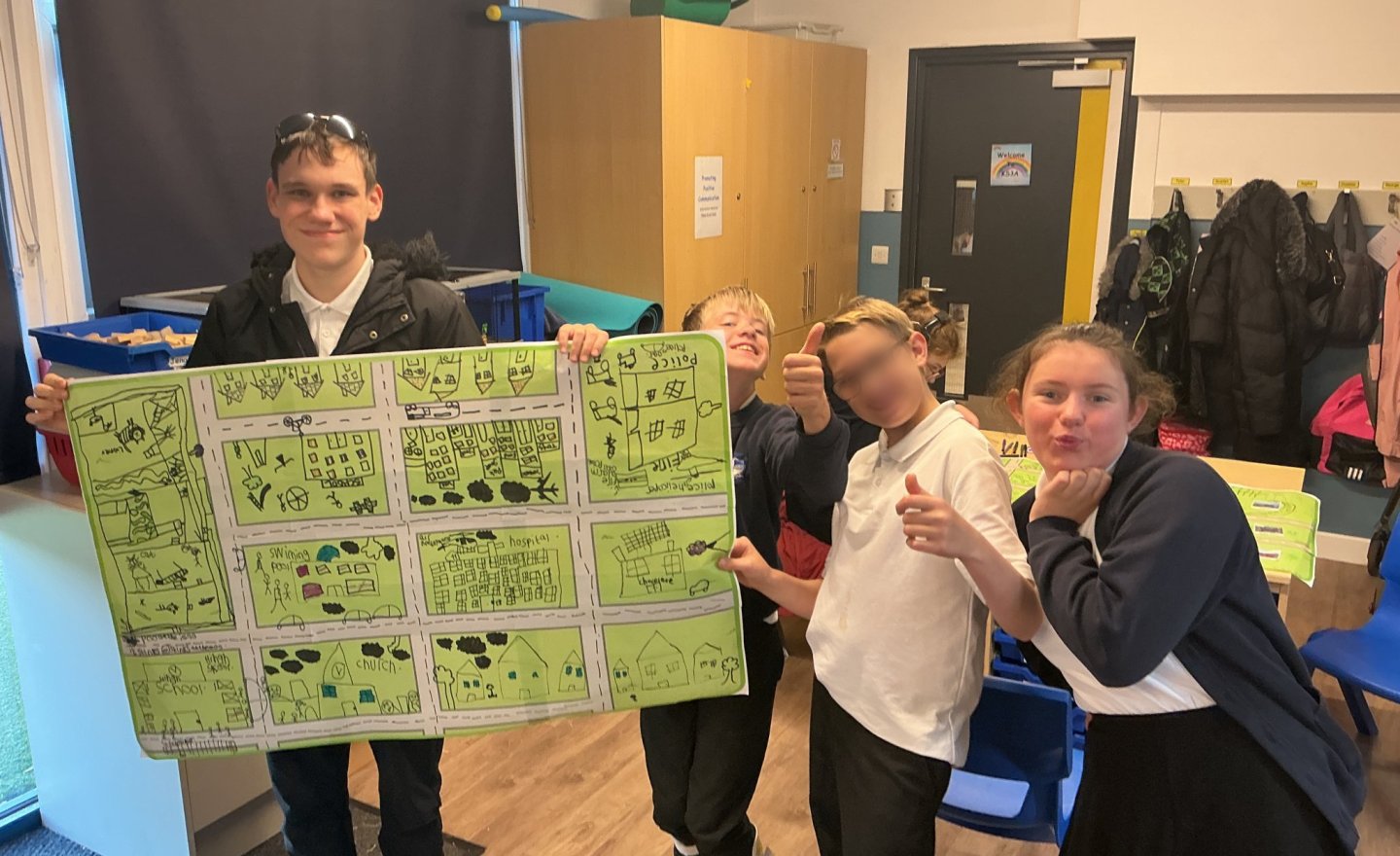
3W - My World - 14/10/26
This week, 3W enjoyed Mrs Seery's My World lesson.
The students worked as part of a team to discuss their perfect town, discussing what they 'needed' and what they 'wanted' to include.
Mrs Seery’s class in KS3,
Designed a dream town for all to see.
They worked as a team,
To build…
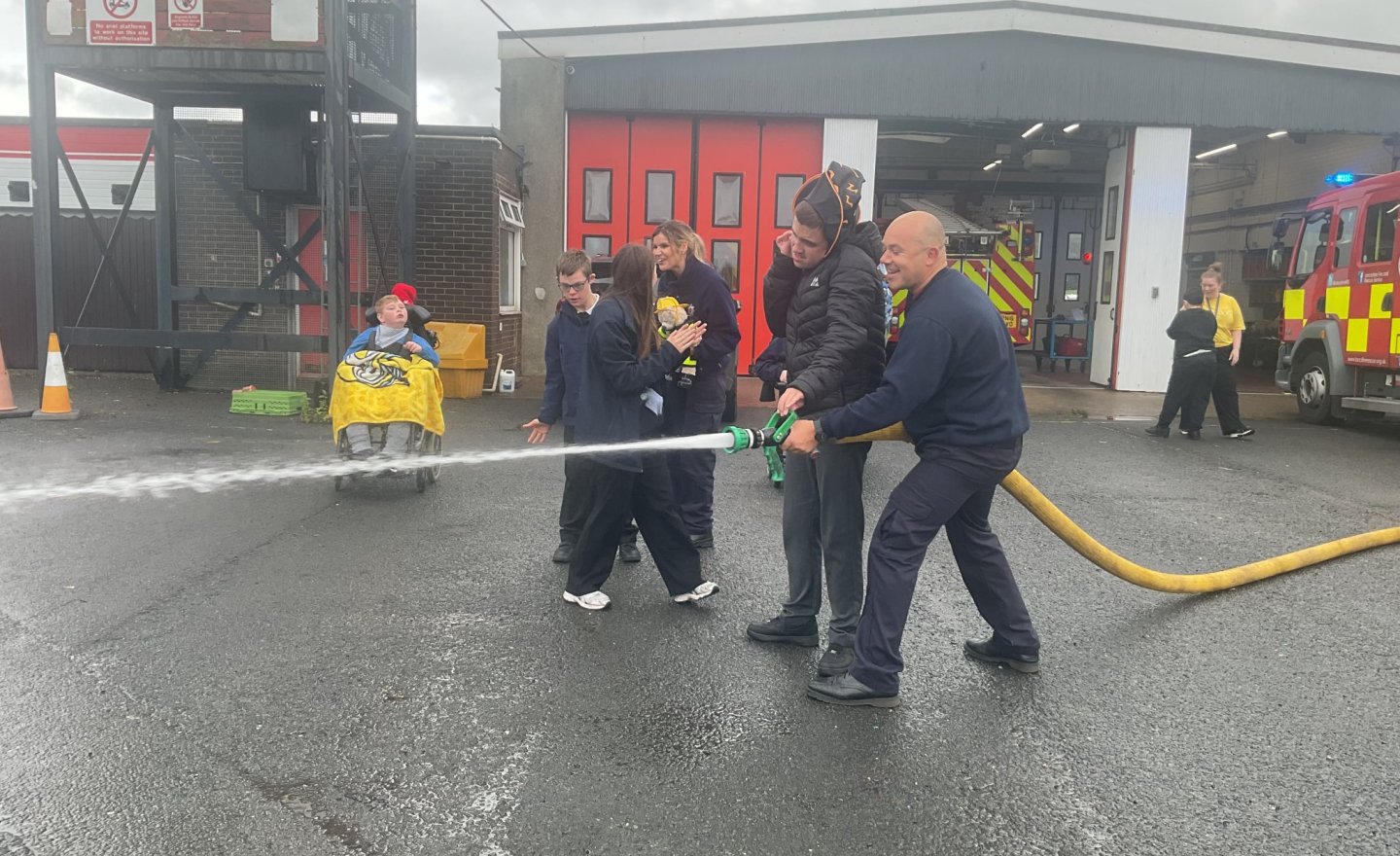
KS3S visit to Skelmersdale Fire Station
As part of our Careers curriculum. KS3S had a fantastic visit to Skelmersdale fire station. We got to explore a real fire engine and had a go on the hose pipe. Student's also enjoyed dressing up and watching the lights and sirens go off on the engine.
A big thank you to the team at the station…